
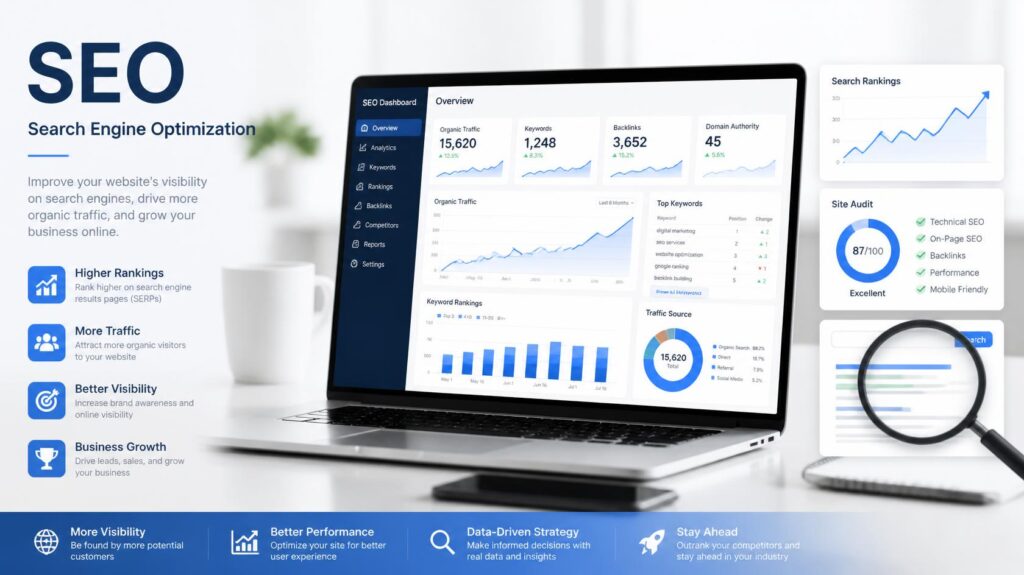
SEO for business websites plays an important role in helping potential customers discover a company through Google and other search engines.
Having a professional website is an important first step, but simply publishing a website does not guarantee that people will find it. A business may have excellent products, useful services, and a well-designed website, yet still receive very little organic traffic if its pages are difficult for search engines and users to discover.
This is where search engine optimization, commonly known as SEO, becomes important.
SEO involves improving different aspects of a website so that search engines can better understand its content and users can more easily find relevant information.
For businesses, the goal is not simply to rank for as many keywords as possible. The real objective is to become visible when potential customers are searching for information, products, or services related to what the business offers.
In other words, a professional website gives your business a digital home, while SEO helps more relevant people discover that digital home through search.
What Is SEO for Business Websites?
SEO for business websites is the process of improving a company’s website so that search engines can understand its content and users can discover relevant pages through organic search.
This can involve several areas, including keyword research, useful content, website structure, page titles, internal linking, technical performance, mobile usability, and other factors that contribute to search visibility.
A successful SEO strategy does not focus only on search engines. Instead, it should also make the website more useful and easier to navigate for real visitors.
When these elements work together, a business website has a better opportunity to attract people who are actively searching for related information, products, or services.
Why SEO Matters for Business Websites
A business website can be valuable even without SEO, but its potential reach may be limited if customers cannot easily discover it.
Think about a customer who needs a particular service. They may not know your company yet. Instead, they might search Google for terms related to the problem they want to solve.
For example, someone looking for professional web design may search for phrases such as “business website design,” “website development services,” or “web design agency.”
If your website contains useful, relevant pages addressing those needs, search engines have more information to understand what your business offers.
SEO can therefore help connect businesses with people who already have a relevant need or question.
Furthermore, organic search can become a long-term source of website traffic. Unlike a temporary promotional campaign, a useful page can continue attracting visitors as long as it remains relevant, accessible, and competitive in search results.
This is one reason SEO is particularly valuable for businesses that want to build sustainable online visibility rather than depending entirely on paid advertising or social media.
SEO Is More Than Adding Keywords to a Website
One of the biggest misconceptions about SEO is that businesses simply need to add keywords to their website as many times as possible.
In reality, effective SEO is much broader than keyword placement.
Search engines need to understand what each page is about, how pages relate to each other, and whether the content provides useful information for visitors.
This means businesses should focus on creating clear, helpful, and relevant content instead of repeating the same keyword throughout a page.
For example, a company offering website development services could create a dedicated service page explaining its process, capabilities, target customers, and expected outcomes.
The company could then publish educational articles answering common questions about website development, SEO, website maintenance, and digital strategy.
As a result, the website begins to provide useful information across multiple stages of the customer’s research process.
Keywords still matter because they help businesses understand what people are searching for. However, keywords should be used naturally within genuinely useful content.
Understanding Search Intent for Business Websites
Search intent refers to the reason behind a user’s search.
Someone searching “what is SEO” is likely looking for educational information. Someone searching “SEO services for small business” may already be researching potential providers. Meanwhile, someone searching for a specific company name is likely trying to find that business directly.
Understanding these differences helps businesses create the right type of content for each audience.
A business website can address different search intents through different pages.
For example:
- Service pages can target people looking for specific solutions.
- Product pages can provide detailed information for potential buyers.
- Blog articles can answer educational questions.
- Case studies can demonstrate experience and results.
- FAQ pages can address common customer concerns.
- Contact pages can help visitors take the next step.
Therefore, SEO should not be treated as a single page optimization task. It is better understood as an ongoing process of making the entire website more useful and discoverable.
How to Choose Keywords for a Business Website
Choosing the right keywords is an important part of SEO for business websites. However, businesses should not simply choose keywords because they have a high search volume.
Instead, keywords should be relevant to the products, services, audience, and goals of the business.
A good starting point is to think about the questions and problems your potential customers have.
For example, a web design company might target topics related to:
- Business website design
- Website development services
- Professional websites
- Company profile websites
- SME websites
- Website maintenance
- Website redesign
- SEO for business websites
Furthermore, businesses should consider the intent behind each keyword. A broad keyword may attract many searches but may not always attract people who are ready to become customers.
A more specific search may have fewer searches but stronger commercial intent.
Therefore, the goal should be to build a balanced keyword strategy that covers informational, commercial, and transactional searches relevant to the business.
Optimize Page Titles and Headings
Page titles and headings help both users and search engines understand what a page is about.
Every important page on a business website should have a clear and descriptive title that reflects its main topic.
For example, a company offering website development services should have a dedicated page with a descriptive title rather than using a generic title such as “Services.”
Headings should also organize the content into logical sections. The main page topic should generally use an H1, while supporting sections can use H2 and H3 headings.
In addition, relevant keywords can be included naturally in titles and headings when they accurately describe the content.
Avoid creating headings solely for search engines. A visitor should be able to scan the page and understand its structure quickly.
Clear headings therefore contribute to both search optimization and user experience.
Create Useful Content That Answers Customer Questions
Content is one of the most important parts of SEO for business websites and a long-term SEO strategy.
Businesses should create content that helps potential customers understand their products, services, problems, and possible solutions.
For example, a website development company could publish articles explaining how to choose a business website, how much website development may cost, how to prepare content for a new website, or how website maintenance works.
These articles can attract people who are still researching their options.
At the same time, service pages can provide more direct information for visitors who are closer to making a decision.
The goal is not to publish as many articles as possible. Instead, businesses should focus on creating content that is accurate, useful, relevant, and genuinely helpful.
Over time, a collection of useful content can strengthen the website’s topical coverage and provide more opportunities for potential customers to discover the business through search.
Use Internal Links to Connect Your Website Content
Internal linking is another useful part of SEO for business websites.
An internal link connects one page on your website to another relevant page on the same website. These links can help visitors discover related information while also helping search engines understand the relationship between different pages.
For example, a website development article can link to a relevant web design service page. An SEO article can link to an article explaining why businesses need a professional website.
This creates a connected content structure rather than a collection of isolated pages.
For Rafora Digital, this approach can connect educational blog content with relevant service pages and other articles.
For example, readers can also learn more from our article Why Your Business Needs a Professional Website in the Digital Era, which explains why a professional website can be an important foundation for a business’s digital presence.
Similarly, our article Website vs Social Media for Business explores how websites and social media can work together as part of a broader digital strategy.
As a result, visitors have more opportunities to explore related topics while moving naturally through the website.
Make Your Business Website Easy to Use on Mobile
A large portion of online activity takes place on mobile devices, so businesses should make sure their websites provide a good experience across different screen sizes.
A mobile-friendly website should be easy to read, navigate, and interact with without unnecessary zooming or horizontal scrolling.
For example, buttons should be easy to tap, menus should be simple to understand, and important information should remain accessible on smaller screens.
Website performance also matters. Visitors may leave when pages take too long to load or when a website feels difficult to use.
Therefore, mobile usability should be considered from the beginning of the website development process rather than treated as an afterthought.
A website that works well on desktop but provides a poor mobile experience can create unnecessary friction for potential customers.
Ultimately, SEO and user experience should work together. A page may attract visitors through search, but the website still needs to provide a clear and useful experience once those visitors arrive.
Pay Attention to Technical SEO
Technical SEO is an important part of SEO for business websites. It helps search engines access, understand, and process a website.
For a business website, this can include factors such as crawlability, indexing, site structure, URLs, mobile usability, page performance, and secure connections.
A technically sound website makes it easier for search engines to discover and understand its pages.
In addition, businesses should make sure important pages are accessible and that unnecessary technical issues do not prevent search engines from processing the site properly.
Technical SEO does not mean that every business owner needs to become a developer. However, it is important to work with a website developer or SEO professional who understands these fundamentals when building or maintaining a business website.
Ultimately, technical quality provides the foundation that allows content and other SEO efforts to perform effectively.
For additional guidance, businesses can review Google’s Search Essentials to understand the key requirements and best practices related to appearing in Google Search.
Google’s SEO Starter Guide also provides practical guidance for helping search engines understand website content and improving a site’s search presence.
Use Local SEO to Reach Nearby Customers
Local SEO can be particularly valuable for businesses that serve customers in a specific city, region, or geographic area.
For example, a local restaurant, dental practice, construction company, marketing agency, or professional service provider may want to appear when people search for relevant services in their area.
A business website can support local visibility by providing accurate business information, location details, service areas, contact information, and useful locally relevant content.
Businesses should also maintain consistent information across important online platforms.
In addition, creating dedicated pages for genuinely relevant locations or service areas can help customers understand where the business operates.
However, businesses should avoid creating dozens of nearly identical location pages simply to target different keywords. Local content should provide genuine value to people in the area.
Therefore, effective local SEO is about being useful and relevant to a specific community rather than simply adding city names to website pages.
Connect Your Website With Your Google Business Profile
For businesses serving local customers, a Google Business Profile can complement the company’s website and broader SEO strategy.
For example, a potential customer may discover a business through Google Search or Google Maps and then visit its website to learn more about its products or services.
This makes the relationship between local search, the business profile, and the website important.
Businesses should keep essential information accurate and consistent, including the business name, address, phone number, website, opening hours, and relevant service information.
Furthermore, customer reviews can provide useful social proof and help potential customers evaluate a business before visiting its website or contacting the company.
A website and Google Business Profile therefore serve complementary purposes. The profile can help customers discover a local business, while the website can provide more detailed information about what that business offers.
Businesses can also learn more about managing their presence on Google through the official Google Business Profile resources.
Build Website Authority and Trust
Search visibility is not only about publishing content. Businesses also need to establish credibility and demonstrate that their information can be trusted.
One way to build authority is by creating genuinely useful content that demonstrates knowledge and experience in the business’s area of expertise.
A professional website can also showcase case studies, customer testimonials, certifications, company information, portfolio projects, and other evidence that helps visitors understand the business.
External references and mentions can also contribute to a broader online presence. For example, a business may be mentioned by industry publications, local organizations, business directories, partners, or other relevant websites.
However, businesses should focus on earning relevant and trustworthy references rather than trying to acquire as many links as possible.
The same principle applies to content. Publishing large amounts of low-quality material simply to target keywords is unlikely to create a strong long-term foundation.
Instead, businesses should focus on demonstrating real expertise and providing information that genuinely helps their audience.
Turn SEO Traffic Into Business Opportunities
For SEO for business websites to support real business growth, getting visitors from Google is only part of the process. A business website also needs to help those visitors take the next step.
For example, a service website may encourage visitors to request a quote, schedule a consultation, send a message, or contact the company.
Product websites may guide visitors toward product pages, shopping carts, or checkout.
Informational websites can encourage readers to explore related articles, subscribe to updates, or learn more about the company’s services.
Therefore, SEO should be connected to the broader business objective rather than treated as a traffic-generation exercise alone.
A page that receives organic traffic but provides no clear next step may have limited commercial value.
In contrast, a well-structured page can attract relevant visitors, answer their questions, establish trust, and guide them toward an appropriate action.
This is why SEO, website design, content, and conversion strategy should work together.
Turn Your Website Into a Stronger Business Asset
If your website is attracting visitors but not generating enough inquiries or opportunities, it may be time to review its structure, content, user experience, and conversion journey.
Rafora Digital helps businesses create professional digital experiences designed around their customers and business goals.
Create a Clear Website Structure
A clear website structure helps both visitors and search engines understand how information is organized.
For example, a business website might organize its main navigation around Home, About, Services, Portfolio, Blog, and Contact pages.
More complex businesses may need additional categories, service pages, product pages, or resource sections.
The important point is that every important page should have a logical place within the website.
Visitors should be able to move from one section to another without confusion. At the same time, search engines should be able to discover important pages through logical navigation and internal links.
In addition, URLs should be descriptive and easy to understand. A URL such as /website-development-services/ gives users a clearer indication of the page topic than a URL containing random numbers or unrelated characters.
A well-organized structure also makes future growth easier. As the business adds new services or publishes more content, those pages can be integrated into an existing structure instead of becoming isolated pieces of information.
Improve User Experience Alongside SEO
SEO can help people discover a website, but the experience they have after arriving is equally important.
A visitor should be able to quickly understand what the business does, who it serves, and what they can do next.
This means important information should be easy to find, navigation should be intuitive, and pages should not contain unnecessary distractions.
For example, a service page should clearly explain the service, its benefits, who it is designed for, and how visitors can request more information.
Readability also matters. Large blocks of text, unclear headings, poor spacing, or difficult navigation can make a page harder to use.
Furthermore, businesses should consider accessibility when designing their websites. Clear text, meaningful link labels, descriptive image alternative text, and usable navigation can make content easier for a wider range of visitors.
Ultimately, SEO should not be treated as something separate from website usability. A website that is useful to people is also better positioned to support long-term search visibility.
Pay Attention to Website Performance
Website performance can influence how visitors experience a business website.
Pages that load slowly can create frustration, particularly when visitors are using mobile devices or slower connections.
For this reason, businesses should consider performance when selecting hosting, designing pages, choosing images, and adding website functionality.
Large image files, unnecessary scripts, excessive animations, and poorly optimized plugins can all contribute to a slower experience.
A modern website should therefore aim to balance visual design with practical performance.
In addition, performance should be monitored over time. A website that performs well when it is first launched can become slower as new plugins, content, tracking tools, and features are added.
As a result, website maintenance is not only about keeping software updated. It can also involve monitoring performance and addressing issues that affect the visitor experience.
Build Modern Websites for Today’s Users
A modern website should be designed around how people actually use the internet today.
Visitors may access a business website from smartphones, tablets, laptops, and desktop computers. They may also arrive through Google Search, social media, email, advertisements, referrals, or direct links.
Therefore, a modern website needs to provide a consistent experience across different devices and entry points.
This includes responsive layouts, readable typography, clear navigation, accessible buttons, useful content, and fast-loading pages.
Modern design should also serve a purpose. Visual effects and animations can enhance a website when they support communication, but they should not make the site difficult to use.
In other words, modern website design is not simply about making a website look attractive. It is about combining visual quality, usability, performance, accessibility, and business objectives.
For SMEs and growing companies, this balance can help create a website that looks professional without becoming unnecessarily complicated.
When Should You Consider Website Development Services?
Building and optimizing a business website can involve many different skills. Depending on the project, businesses may need help with strategy, UX design, visual design, development, content, SEO, performance, testing, and ongoing maintenance.
For a simple website, a business owner may be able to handle some tasks independently using a website builder or content management system.
However, professional website development services can become valuable when the business needs a more customized solution or does not have the time and expertise to manage the project internally.
For example, a company may need a custom website structure, specific integrations, advanced forms, e-commerce functionality, booking systems, performance optimization, or SEO-focused content architecture.
Working with an experienced website professional can also reduce the risk of building a website that looks attractive but does not support the actual needs of the business.
Ultimately, the right approach depends on the complexity of the project, available resources, budget, and long-term business goals.
Ready to Improve Your Business Website?
A website should do more than simply exist online. It should help potential customers understand your business, discover your services, and take the next step.
Rafora Digital can help businesses build modern, professional websites with usability, SEO, and long-term digital growth in mind.
Build a Stronger Online Presence With Rafora Digital
SEO works best when it is supported by a website that is useful, accessible, trustworthy, and easy to navigate.
If you are ready to improve your business website, Rafora Digital can help you create a modern digital foundation for your next stage of growth.
Frequently Asked Questions About SEO for Business Websites
How does SEO help a business website?
SEO helps a business website become more discoverable in search engines when potential customers search for relevant information, products, or services. It can increase organic visibility, attract relevant visitors, support brand credibility, and create opportunities for leads or sales. The results depend on factors such as competition, content quality, technical SEO, website authority, and search intent.
Is SEO important for small business websites?
Yes. SEO can be particularly useful for small businesses that want to reach people searching for their products or services online. A focused SEO strategy can help a small business compete for relevant searches without relying entirely on paid advertising. Local SEO can also be valuable when a business serves customers in a specific geographic area.
How long does SEO take to work for a business website?
SEO usually takes time because search visibility depends on factors such as website authority, competition, content quality, technical performance, and the search terms being targeted. Some improvements may become noticeable relatively quickly, while meaningful organic growth can take months. Businesses should therefore view SEO as a long-term strategy rather than expecting immediate results after optimizing a few pages.
Can I do SEO myself for my business website?
Yes. Business owners can handle many basic SEO activities themselves, including creating useful content, improving page titles, organizing headings, adding internal links, and making sure important business information is clear. However, more technical or competitive SEO work may require specialized knowledge. Businesses can choose between learning SEO internally, working with an SEO professional, or combining both approaches.
Does having a modern website improve SEO?
A modern-looking website does not automatically rank higher in search results. However, modern website development can support SEO when it includes good usability, mobile responsiveness, clear navigation, accessible content, strong technical foundations, and good performance. Design should therefore support the user experience and business objectives rather than focus only on visual appearance.
What is the difference between SEO and Google Ads?
SEO focuses on improving a website’s organic visibility in search results, while Google Ads uses paid advertising to place advertisements in relevant search results and other Google properties. SEO can provide long-term organic visibility, but it usually takes time to develop. Google Ads can provide faster exposure when a campaign is properly configured and funded. Many businesses use both strategies as part of a broader digital marketing plan.
Should a business focus on SEO or social media?
SEO and social media serve different purposes and can work together. SEO can help people discover a business when they are actively searching for relevant information, products, or services. Social media can help businesses build awareness, engagement, and relationships with their audience. For many businesses, combining a professional website, SEO, and relevant social media channels creates a stronger digital presence than relying on only one channel.