
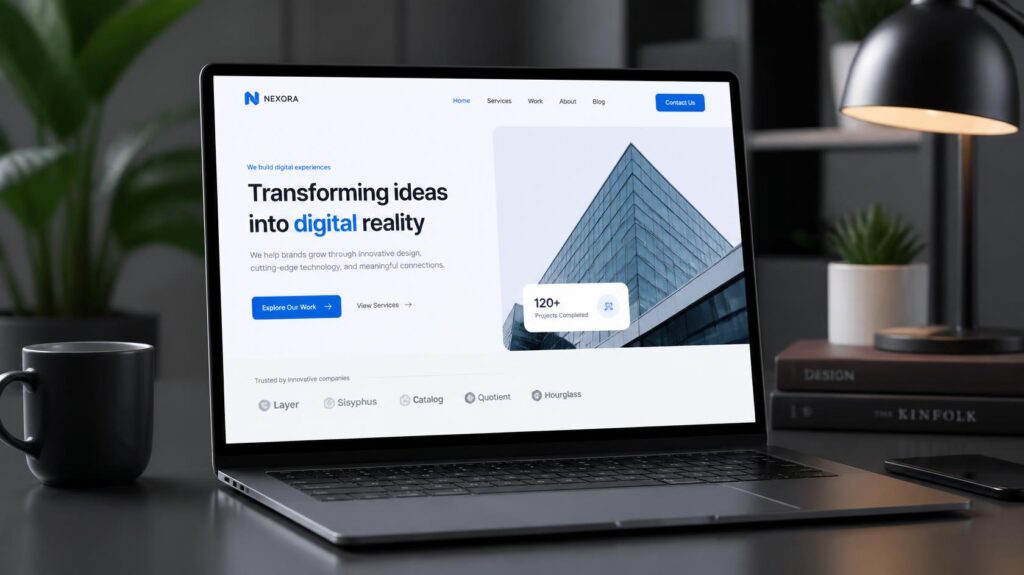
Modern website design is about more than creating a website that looks attractive. For a business, a successful website should communicate clearly, work well across devices, provide a good user experience, and support specific business goals.
A website may have beautiful colors, animations, and professional photography, but these elements alone do not make it effective.
Visitors should be able to understand what the business offers, find important information, navigate between pages, and take the next step without unnecessary friction.
In other words, modern website design combines visual quality with usability, performance, accessibility, and business strategy.
This is particularly important for small and medium-sized businesses. Their website may be one of the first places where potential customers evaluate the company.
A well-designed website can therefore help create a professional first impression while making it easier for visitors to interact with the business.
What Makes a Modern Business Website Effective?
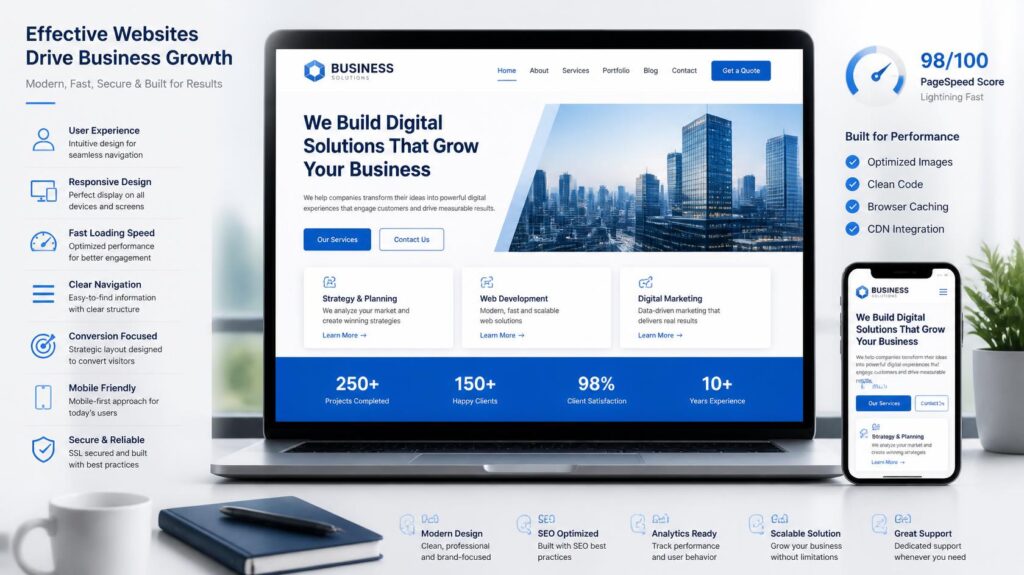
An effective modern website should be easy to understand, simple to navigate, responsive on different devices, reasonably fast, accessible, and aligned with the goals of the business.
It should also provide useful information instead of focusing only on visual appearance.
A strong business website typically combines several elements:
- Clear messaging
- Consistent visual design
- Simple navigation
- Responsive layouts
- Readable typography
- Strong calls to action
- Useful and relevant content
- Good website performance
- Accessible user interfaces
- Search-friendly structure
These elements should work together rather than being treated as separate features.
Ultimately, the best modern website is not necessarily the one with the most animations or visual effects. It is the one that helps visitors accomplish their goals while supporting the business.
Modern Website Design Should Support Business Goals
A business website should have a clear purpose before the visual design begins.
For example, an e-commerce website may focus on product discovery and purchases, while a professional service company may focus on generating inquiries or consultation requests.
A company profile website may primarily need to communicate credibility, services, experience, and contact information.
Therefore, design decisions should be connected to what the business wants visitors to do.
This affects everything from page structure and navigation to button placement, content hierarchy, imagery, and calls to action.
A visually impressive website that makes it difficult for visitors to find important information may perform worse than a simpler website with a clear structure.
In addition, business goals can change over time. A website should therefore be flexible enough to support new services, campaigns, content, and customer needs as the company grows.
Use Clear Visual Hierarchy
Visual hierarchy determines how visitors notice and process information on a page.
Important information should be visually distinguishable from supporting information. Headings, subheadings, buttons, images, spacing, and typography can all help guide attention.
For example, the homepage should make it clear what the company does and what visitors can do next.
A strong headline can communicate the main value proposition, while supporting text can provide additional context.
Similarly, a prominent call-to-action button can guide visitors toward an important action such as requesting a quote, booking a consultation, or contacting the business.
Good visual hierarchy reduces the amount of effort visitors need to understand a page.
As a result, visitors can scan content more easily and find the information that matters to them.
Keep Website Navigation Simple
Navigation is one of the most important parts of a business website because it determines how easily visitors can move between pages.
A website does not need a complicated navigation system to feel professional.
In most cases, a clear menu with logical categories is easier to use than a menu containing too many options.
Common pages for a business website may include:
- Home
- About
- Services
- Portfolio or Projects
- Blog or Resources
- Contact
Larger businesses may need additional categories or more complex navigation structures.
However, every additional option should have a clear purpose.
Visitors should not have to guess where to find information about services, pricing, company information, or contact details.
Ultimately, simple navigation helps users spend less time searching for information and more time engaging with the business.
Need a Modern Website for Your Business?
Your website should reflect the quality of your business and make it easy for customers to understand what you offer.
Rafora Digital can help you create a modern, professional website designed around usability, branding, and business goals.
Make Your Website Responsive Across Devices
A modern business website should work well across different screen sizes, including smartphones, tablets, laptops, and desktop computers.
Responsive website design allows layouts and content to adapt to the device being used.
For example, a multi-column desktop layout may become a single-column layout on a smartphone. Navigation may also change into a mobile-friendly menu.
This matters because visitors should not need to zoom, scroll horizontally, or struggle with small buttons simply because they are using a mobile device.
Responsive design also helps businesses provide a more consistent experience across different devices.
In addition, businesses should test important pages on multiple screen sizes rather than assuming that a website will automatically work perfectly everywhere.
A responsive website is therefore not just a technical feature. It is an important part of creating a practical and accessible user experience.
Google’s developer documentation also provides guidance on designing websites that work well across different devices and screen sizes.
Design for Mobile Users First
Mobile users often interact with websites differently from desktop users. They may be browsing with one hand, using a smaller screen, or accessing a website while moving between locations.
For this reason, important information and actions should be easy to access on mobile devices.
Buttons should have enough space to tap comfortably. Text should remain readable without zooming, and navigation should be simple enough to understand quickly.
Furthermore, businesses should avoid unnecessary pop-ups or elements that cover important content on smaller screens.
A mobile-first mindset can help designers prioritize the most important content and actions before adding more complex elements for larger screens.
Ultimately, a website that works well on mobile can create a smoother experience for visitors regardless of how they discover the business.
Choose Readable Typography
Typography has a major influence on how professional and comfortable a website feels.
A modern website should use fonts that are easy to read across different screen sizes.
For example, body text should generally have enough size, spacing, and contrast to remain comfortable during longer reading sessions.
Headings can use different sizes and weights to create a clear content hierarchy.
However, using too many different fonts can make a website feel inconsistent and distracting.
A simple typography system with a limited number of font families and clearly defined heading styles is often easier to maintain.
In addition, businesses should consider how typography reflects their brand. A technology company, professional service provider, creative agency, and local business may each choose different visual styles.
The goal is to balance brand personality with readability.
Use Colors Consistently With Your Brand
Color is another important part of modern website design.
A business website should use colors consistently so that visitors can recognize the brand across different pages and digital channels.
For example, a primary brand color can be used for important buttons, links, or visual accents, while neutral colors can provide a clean background for content.
Too many competing colors can make a website feel visually confusing.
At the same time, businesses should not choose colors based only on personal preference. Contrast, readability, accessibility, and brand positioning should also be considered.
A consistent color system can make a website feel more organized and professional.
Furthermore, consistent branding across the website, social media, presentations, and other digital materials can create a stronger overall identity.
Use High-Quality Images With Purpose
Images can make a business website more engaging, but every visual element should have a purpose.
For example, a company profile website may use team photography to introduce the people behind the business. A portfolio website may use project images to demonstrate previous work.
Product businesses can use high-quality product photography to help customers understand what they are considering.
However, large or unnecessary images can negatively affect website performance.
Businesses should therefore optimize images before uploading them and choose appropriate file formats and dimensions.
In addition, images should include meaningful alternative text when appropriate. This can help describe relevant visual content to visitors who use assistive technologies and can also provide useful context when images cannot be displayed.
The best visual content supports the message of the page instead of simply filling empty space.
Make Modern Websites Accessible
Accessibility should be considered when creating a modern website. A website should be usable by as many people as reasonably possible, including visitors who use assistive technologies.
Businesses can also refer to the W3C Web Accessibility Initiative for guidance on making web content more accessible.
For example, sufficient color contrast can make text easier to read, while descriptive link labels can make navigation clearer.
Images that communicate important information should also have appropriate alternative text.
In addition, interactive elements such as buttons, menus, and forms should be easy to identify and use.
Accessibility is not only about following technical guidelines. It is also about creating a better experience for people with different abilities, devices, and browsing preferences.
Therefore, accessibility should be considered from the beginning of the design process rather than added as an afterthought.
Prioritize Website Performance
A modern website should also perform well.
Visitors may leave when pages take too long to load, images are unnecessarily large, or interactive elements respond slowly.
For this reason, performance should be considered during both design and development.
Businesses can improve performance by optimizing images, reducing unnecessary scripts, choosing suitable hosting, and avoiding excessive website features that provide little value.
At the same time, performance should not come at the expense of usability. A website needs to provide enough visual content and functionality to communicate effectively with visitors.
Regular monitoring can also help identify performance problems after a website has been launched.
Ultimately, good performance supports a smoother user experience and helps visitors access important information with less friction.
Google also provides guidance on page experience and the factors that can contribute to a better experience for website visitors.
Organize Content for Easy Reading
Even a beautifully designed website can be difficult to use when its content is poorly organized.
Modern websites should make information easy to scan and understand.
Short paragraphs, descriptive headings, bullet lists, clear spacing, and visual separation can make longer pages easier to navigate.
Important information should appear where visitors are most likely to need it.
For example, a service page could begin with a clear explanation of the service, followed by its benefits, process, frequently asked questions, and a relevant call to action.
This structure allows visitors to find answers without having to read every sentence.
Furthermore, content should be written for the target audience rather than simply filling pages with marketing language.
Clear and useful content can make a website feel more trustworthy and professional.
Use Clear Calls to Action
A business website should make it clear what visitors can do next.
A call to action, commonly known as a CTA, guides visitors toward a specific action that supports the business objective.
Examples include:
- Request a quote
- Book a consultation
- Contact the business
- View services
- Explore the portfolio
- Download a guide
- Make a purchase
The appropriate CTA depends on the purpose of the page.
For example, a blog article may encourage readers to explore a related service, while a service page may encourage visitors to request a consultation.
CTAs should be clear without becoming overly aggressive.
Ultimately, good website design helps visitors understand both the value of the business and the next step they can take.
Build Trust With Professional Website Elements
A website is often one of the first places where potential customers evaluate a business.
For this reason, trust should be considered an important part of modern website design.
Businesses can strengthen credibility by clearly presenting information such as company details, contact information, services, portfolio projects, customer testimonials, certifications, case studies, and relevant experience.
For example, a company profile website can introduce the business, explain its expertise, and demonstrate previous projects.
Customer reviews and testimonials can also provide social proof when they are genuine and presented transparently.
In addition, businesses should make it easy for visitors to find ways to contact them.
A professional design combined with clear information can reduce uncertainty and help visitors feel more confident about engaging with the business.
Modern Website Design for Small and Medium-Sized Businesses
Small and medium-sized businesses do not necessarily need the most complicated website. They need a website that supports their customers and business objectives.
For many SMEs, a clear and professional website can provide essential information about the company, services, products, location, contact details, and customer support.
A smaller website can still use modern design principles such as responsive layouts, clear navigation, readable typography, strong visual hierarchy, and useful calls to action.
The key is to prioritize what customers actually need.
An SME website may begin with a relatively simple structure and expand as the business grows. Additional service pages, case studies, blog content, or online features can be added over time.
This approach can be more practical than building a complex website filled with features that the business does not currently need.
Designing Effective Company Profile Websites
Company profile websites are designed to introduce a business and communicate its credibility, capabilities, services, and identity.
A strong company profile website should answer several basic questions: Who is the company? What does it offer? Who does it serve? Why should customers trust it? And how can visitors get in touch?
The design should support these answers rather than distract visitors with unnecessary visual elements.
For example, an About page can explain the company’s background and values, while service pages can provide more detailed information about what the business offers.
Portfolio projects, case studies, certifications, testimonials, and team information can also help demonstrate experience when they are relevant to the business.
As a result, a well-structured company profile website can function as more than an online brochure. It can become an important part of the company’s digital presence and customer journey.
Combine Modern Design With SEO
Modern website design and SEO should not be treated as separate strategies.
A visually attractive website still needs useful content, clear page structure, descriptive headings, accessible navigation, and search-friendly technical foundations.
Similarly, an SEO-focused website should still provide a professional and enjoyable experience for visitors.
For example, a business website can use clear headings and descriptive page titles while maintaining a consistent visual identity.
Internal links can connect related pages, while well-organized content can make information easier for both visitors and search engines to understand.
This balance is particularly important for businesses that want their website to attract visitors through organic search and then turn those visitors into customers.
If you want to learn more about this topic, our guide on SEO for Business Websites explains how businesses can improve their search visibility and create a stronger organic presence.
This creates a natural connection between website design and SEO rather than treating them as two unrelated activities.
Keep Your Modern Website Updated
Launching a modern website is not the end of the process.
Websites require ongoing maintenance to remain secure, functional, accurate, and useful.
Regular maintenance can include updating software, checking forms, reviewing links, monitoring performance, refreshing outdated content, and addressing technical problems.
Businesses should also review their website content periodically.
Services may change, contact information may need updating, and older articles may become outdated.
In addition, customer behavior can provide useful information about which pages perform well and where visitors may encounter problems.
A website that is regularly reviewed can continue to support the business as its needs evolve.
Therefore, website maintenance should be considered part of the overall website investment rather than an optional task after launch.
Think of Your Website as a Long-Term Business Asset
A professional website should not be viewed simply as a digital business card. Learn more about why businesses need a professional website in our guide, Why Your Business Needs a Professional Website in the Digital Era.
When properly planned and maintained, it can become a long-term business asset that supports marketing, sales, customer communication, branding, and online visibility.
A website can educate potential customers before they contact the business, showcase previous work, answer common questions, collect inquiries, and provide information at any time.
Furthermore, a website gives businesses greater control over their digital presence compared with relying entirely on third-party platforms.
Social media platforms and other channels can change their algorithms, features, or policies. A business website provides a central destination where customers can find the company’s own information and resources.
This does not mean businesses should ignore social media. Instead, the website and other digital channels can work together as part of a broader strategy.
Ultimately, investing in modern website design is about creating a digital foundation that can continue to support the business as it grows.
Ready to Build a Better Business Website?
Whether you need a new company profile website, an SME website, or a redesign of an existing site, the right strategy can make your website more useful for both your business and your customers.
Talk to Rafora Digital about your website project and discover how a modern digital presence can support your business goals.
Let’s Build Your Modern Website
A modern website should look professional, work smoothly, and help visitors take the next step.
If you’re ready to improve your online presence, Rafora Digital is ready to help turn your website idea into a professional digital experience.
Frequently Asked Questions About Modern Website Design
What makes a website look modern?
A modern website typically combines a clean visual design with clear navigation, readable typography, responsive layouts, useful content, good performance, and a consistent brand identity. Modern design is not simply about using the latest visual trends. It should make the website easier to understand and use while supporting the goals of the business.
How much does modern website design cost?
The cost of modern website design can vary significantly depending on the project’s scope, number of pages, design requirements, functionality, integrations, content, and development approach. A simple company profile website may require fewer resources than an e-commerce platform or a website with custom functionality. Businesses should therefore define their requirements and goals before comparing website development costs.
Is responsive web design important for a business website?
Yes. Responsive web design helps a website adapt to different screen sizes, including smartphones, tablets, laptops, and desktop computers. This can make content easier to read and navigation easier to use across devices. Since many people access websites through mobile devices, responsive design should be considered an essential part of a modern business website.
What is the difference between a modern website and a traditional website?
A modern website generally places greater emphasis on responsive design, usability, accessibility, performance, clear content structure, and consistent user experience across devices. A traditional website may still work effectively, but it may use older layouts, technologies, or design approaches. The most important difference is not appearance alone, but how effectively the website serves its users and business goals.
What should a small business website include?
A small business website should usually include clear information about the company, its products or services, contact details, and the areas it serves. Depending on the business, useful sections may also include an About page, service pages, portfolio, testimonials, FAQs, blog content, and clear calls to action. The structure should prioritize the information that potential customers need to make decisions.
Does website design affect SEO?
Website design can influence SEO indirectly and directly through factors such as mobile usability, site structure, navigation, page performance, accessibility, and content organization. A visually attractive website can still perform poorly in search if important content is difficult to access or technical foundations are weak. Good website design should therefore work together with SEO rather than being treated as a separate activity.
Should I redesign my existing business website?
A redesign may be worth considering when an existing website is difficult to use, outdated, slow, not mobile-friendly, poorly structured, or no longer reflects the business. However, a redesign should not be based on appearance alone. Businesses should first identify the problems with the current website and determine how a new design can improve usability, performance, SEO, and business results.