
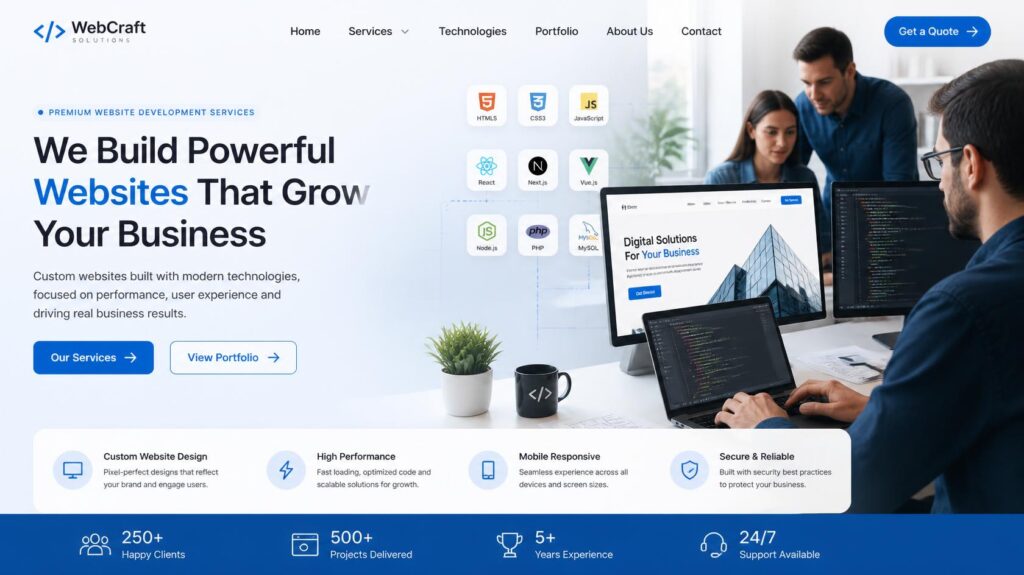
Website development services can help businesses turn an idea, business requirement, or website concept into a functional digital presence.
For many businesses, a website is no longer simply an online brochure. It can support marketing, customer communication, lead generation, e-commerce, bookings, portfolios, and other important business activities.
However, choosing the right website development approach can be challenging. Businesses may need to compare different technologies, development methods, providers, features, pricing models, and maintenance options.
Businesses should plan a professional website around their needs rather than build one simply because having a website is expected.
The right development partner should understand both the technical requirements and the business objectives behind the project.
This guide explains what businesses should consider when evaluating website development services and how to choose an approach that can support their goals over the long term.
What Are Website Development Services?
Website development services involve the technical planning, building, testing, deployment, and maintenance of a website.
Depending on the project, development services may include website architecture, front-end development, back-end development, content management systems, database integration, APIs, forms, e-commerce functionality, performance optimization, security, and ongoing maintenance.
The exact scope depends on what the business needs.
For example, a small company may only need a professional company profile website with several pages and a contact form. An e-commerce business may require product management, shopping carts, payments, customer accounts, and order processing.
Therefore, businesses should evaluate website development services based on more than the number of features. The most important question is whether the development approach provides the functionality, usability, reliability, and scalability the business actually needs.
Website Design vs Website Development
Website design and website development work closely together, but they serve different purposes.
For a deeper look at the design principles behind an effective business website, see our guide to Modern Website Design.
Website design generally focuses on how a website looks and how users interact with it. This can include visual identity, layouts, typography, colors, navigation, user experience, and content presentation.
Website development, on the other hand, focuses more heavily on turning those designs and requirements into a functioning website.
For example, a designer may create the layout and user interface for a contact form, while a developer makes sure the form works correctly and handles submitted information appropriately.
In practice, the two areas should work together.
A website can look excellent but perform poorly if its development is weak. Similarly, a technically functional website may not provide a good experience if its design and usability have not been properly considered.
For businesses, choosing a provider that understands both design and development can help create a more consistent final product.
Start With Your Business Goals
Before choosing a website development service, businesses should define what they want the website to achieve.
For example, the primary goal may be to generate leads, sell products, provide information, receive bookings, showcase a portfolio, build credibility, or support existing customers.
These goals influence the website’s structure, features, content, and technology requirements.
A company that mainly needs to generate inquiries may not need the same functionality as an online retailer.
Similarly, a professional service provider may prioritize service pages, case studies, testimonials, and consultation forms.
Defining goals early can help businesses avoid paying for unnecessary features while ensuring that important functionality is included.
Ultimately, the best website is not necessarily the one with the most features. It is the one that solves the right business problems.
Understand What the Website Development Project Includes
Businesses should understand exactly what is included in a website development project before work begins.
A clear project scope can include the number of pages, design responsibilities, development features, content requirements, integrations, responsive behavior, testing, deployment, and post-launch support.
For example, businesses should clarify whether the website provider is responsible for creating the content, uploading images, configuring forms, setting up analytics, optimizing performance, or handling technical integrations.
The project scope should also identify what happens after the website launches.
Will the provider offer maintenance? Are software updates included? What happens if a technical issue appears?
Asking these questions early can prevent misunderstandings later.
A clear scope also makes it easier to compare different website development services because businesses can evaluate providers based on what they actually deliver rather than comparing prices alone.
Looking for Professional Website Development Services?
Your website should be built around your business goals, customers, and long-term needs.
Rafora Digital can help you plan and develop a professional business website with a focus on design, usability, performance, and SEO-ready structure.
Custom Website Development vs Website Templates
Businesses often have to choose between using a pre-built template and investing in a more customized website development approach.
Templates can provide a faster starting point and may be suitable for businesses with simple requirements and limited budgets.
Custom website development, however, can provide greater flexibility when a business has specific design, functionality, integration, or scalability requirements.
For example, a business may need a unique customer portal, booking system, product configuration tool, or integration with another platform.
In these situations, a highly customized solution may be more appropriate than trying to adapt a template beyond its intended purpose.
The right choice depends on the project’s requirements, budget, timeline, and long-term plans.
The goal should not be to choose the most expensive option. It should be to choose an approach that provides the right balance between functionality, flexibility, cost, and maintainability.
Consider WordPress for Flexible Business Websites
WordPress is one option businesses can consider when developing a professional website.
WordPress provides official documentation and resources for businesses and developers who want to learn more about the platform.
It can be useful for businesses that want a content management system that allows website content to be updated without requiring developers for every small change.
Businesses can use WordPress for company profile websites, service websites, blogs, portfolios, and various other types of digital platforms.
Its ecosystem also provides access to themes, plugins, integrations, and other tools that can extend website functionality.
However, simply installing WordPress does not automatically create a professional website.
The quality of the final result depends on factors such as design, development, hosting, plugin selection, security, performance, content structure, and ongoing maintenance.
Therefore, businesses should evaluate how WordPress will be configured and maintained rather than choosing it solely because it is popular.
Make Responsive Development a Priority
Responsive development should be an important consideration when evaluating website development services.
A website should provide a usable experience across smartphones, tablets, laptops, and desktop computers.
This means the development process needs to account for different screen sizes, navigation patterns, touch interactions, images, forms, and content layouts.
A website that looks excellent on a desktop but becomes difficult to use on a smartphone can create unnecessary friction for potential customers.
For example, buttons should be easy to tap, forms should remain usable, text should be readable, and important information should not disappear on smaller screens.
Responsive behavior should therefore be tested throughout development rather than checked only after the website is completed.
A professional development process should consider different devices from the beginning.
Choose an SEO-Ready Development Approach
Website development and SEO should work together from the beginning.
Google Search Central also provides documentation about creating websites that can be effectively discovered and understood by search engines.
You can also learn more about improving search visibility in our guide to SEO for Business Websites.
An SEO-ready website should provide a solid technical foundation for search engines to discover, understand, and process its content.
This can involve clear page structures, descriptive URLs, appropriate heading hierarchy, crawlable pages, mobile usability, internal linking, performance considerations, and properly structured content.
Businesses should also be able to manage important SEO elements such as page titles, meta descriptions, image alternative text, and relevant content.
However, SEO-ready development does not guarantee high search rankings.
Search visibility also depends on content quality, competition, authority, search intent, and many other factors.
The goal is to make sure the website does not create unnecessary technical barriers that could limit future SEO efforts.
For businesses investing in website development services, this foundation can make future content and SEO work more effective.
Prioritize Website Performance
Website performance can directly affect how visitors experience a business website.
Pages that load slowly can frustrate users and may reduce the likelihood that visitors continue browsing.
Developers should consider performance during development rather than treat it as an issue to fix after launch.
Developers can consider factors such as image optimization, efficient code, hosting infrastructure, caching, scripts, plugins, and other website components that influence loading behavior.
At the same time, performance should be balanced with functionality and visual quality.
A business website still needs useful content, high-quality visuals, forms, analytics, and other features that support its goals.
The objective is not simply to make a website as small as possible. It is to create a website that provides the functionality visitors need without unnecessary performance overhead.
Consider Website Security From the Start
Website security should be considered throughout the development process.
Businesses may collect contact information, customer data, account credentials, payments, or other sensitive information through their websites.
The appropriate security measures depend on the type of website and the information it handles.
Basic considerations can include secure connections, strong authentication practices, software updates, secure hosting, access controls, backups, and appropriate protection against common web threats.
For WordPress websites, keeping the core software, themes, and plugins updated can also help reduce security risks.
Businesses should also limit administrative access to people who actually need it.
Security is not a one-time task. It should remain part of ongoing website maintenance after the website has been launched.
Make Testing Part of Website Development
Testing should be an important part of every website development project.
A website may appear to work correctly during development but still contain problems that only become visible when different users, devices, browsers, or situations are tested.
Website testing can include checking navigation, forms, buttons, links, responsive layouts, content, loading behavior, and other important functionality.
Businesses with more complex websites may also need additional testing for integrations, user accounts, payments, search features, or other custom functionality.
For example, a contact form should not only look correct. It should also successfully submit information, provide appropriate feedback, and deliver the submission to the intended destination.
Testing before launch can help identify problems before they affect customers.
After launch, ongoing monitoring and testing can help detect issues caused by software updates, integrations, content changes, or other modifications.
Evaluate Required Integrations
Many businesses need their websites to connect with other tools and services.
Examples include:
- Payment gateways
- Email marketing platforms
- Customer relationship management systems
- Analytics tools
- Booking systems
- Social media platforms
- Inventory systems
- Customer support tools
- Third-party APIs
The complexity of these integrations can vary significantly.
For example, adding a simple analytics tool may require relatively little development work, while connecting an e-commerce website to an external inventory or enterprise system may require more complex development.
Businesses should identify important integrations before development begins.
This allows the development team to evaluate technical requirements, compatibility, security, and potential costs early in the project.
Planning integrations early can also reduce the risk of discovering major technical limitations after the website has already been built.
Include Accessibility in the Development Process
Accessibility should be considered when developing websites so that as many people as reasonably possible can use them.
Accessible development can involve factors such as keyboard navigation, readable text, sufficient color contrast, descriptive labels, alternative text, and clear interaction states.
Forms should also provide understandable labels and feedback when users make mistakes.
Accessibility benefits more than users with permanent disabilities. It can also improve usability for people experiencing temporary limitations, using different devices, or accessing websites in challenging environments.
Businesses should therefore consider accessibility during design, development, and testing.
Building accessibility into the process from the beginning is generally more practical than trying to fix every issue after launch.
The W3C Web Accessibility Initiative provides additional guidance on creating accessible web content and experiences.
Plan for Website Maintenance
Website development does not necessarily end when a website goes live.
Websites require ongoing maintenance to remain secure, functional, accurate, and compatible with changing technologies.
Maintenance may include software updates, backups, security checks, performance monitoring, broken-link checks, content updates, and technical troubleshooting.
The amount of maintenance required depends on the type and complexity of the website.
A simple company profile website may require less ongoing work than an e-commerce platform with customer accounts, payments, and multiple integrations.
Businesses should therefore ask website providers what maintenance and support options are available after launch.
Understanding this before signing a project agreement can help businesses plan their long-term website costs and responsibilities.
Understand Website Development Costs
The cost of website development services can vary widely depending on the project’s requirements.
Factors that can influence the cost include the number of pages, design complexity, custom functionality, integrations, content requirements, technology, development time, hosting, and ongoing maintenance.
A simple business website may require significantly fewer resources than an e-commerce platform or a custom web application.
Businesses should therefore avoid comparing website providers based only on the initial price.
A lower price may not include important services such as content preparation, testing, SEO setup, security, maintenance, or post-launch support.
Instead, businesses should compare the overall value and clearly understand what is included in each proposal.
A detailed scope of work can make these comparisons much easier.
How to Choose the Right Website Development Provider
Choosing the right website development provider requires more than looking at a portfolio.
A professional website can also play an important role in building credibility and creating a stronger digital presence for a business.
Businesses should consider the provider’s experience, communication process, technical capabilities, project approach, support options, and understanding of business objectives.
A provider should also be able to explain technical decisions in a way that business owners and non-technical stakeholders can understand.
Reviewing previous projects can help businesses evaluate the provider’s design quality and technical capabilities.
However, businesses should also ask about how projects are planned, tested, launched, and maintained.
Important questions may include:
- What is included in the project?
- Who owns the website and its content?
- What technologies will be used?
- How will the website be tested?
- Is SEO setup included?
- What happens after launch?
- Is ongoing maintenance available?
The answers can help businesses determine whether a provider is a suitable long-term partner rather than simply a company that builds websites.
Need Help Building Your Business Website?
Choosing the right development approach can make a significant difference to your website’s usability, performance, and long-term value.
If you have a website idea or need to improve an existing website, Rafora Digital can help turn your requirements into a practical digital solution.
Understand the Website Development Process
A structured development process can help keep a website project organized and reduce misunderstandings.
A typical process may include:
- Business and project requirements
- Information architecture and planning
- Design and user experience
- Development
- Content implementation
- Testing and quality assurance
- Launch
- Maintenance and ongoing improvements
The exact process may vary depending on the provider and project complexity.
For example, a small company website may move through these stages relatively quickly, while a larger project may require additional planning, prototypes, testing cycles, and stakeholder reviews.
A clear process helps everyone understand what happens at each stage.
It also gives businesses opportunities to provide feedback before the final website is launched.
Clarify Website Ownership and Access
Website ownership is an important consideration that businesses sometimes overlook when choosing website development services.
Before a project begins, businesses should understand who owns the website, domain, hosting account, content, design assets, and other important project components.
Businesses should also have appropriate administrative access to systems that they own or are responsible for managing.
This is particularly important when a business decides to change providers in the future.
For example, losing access to a domain or hosting account can create unnecessary complications when moving a website or making technical changes.
Clear agreements about ownership and access can help protect the business and provide greater flexibility in the future.
Think About Future Website Growth
A website should be designed with the business’s future needs in mind.
A company may start with a simple website but later need additional services, landing pages, content, e-commerce features, integrations, or customer functionality.
A scalable development approach can make it easier to expand the website without rebuilding everything from scratch.
This does not mean businesses need to build every possible feature from the beginning.
Instead, the initial architecture should be appropriate for the current project while allowing reasonable room for future improvements.
Businesses should discuss potential future requirements with their development provider before development begins.
This can help identify technical decisions that may affect future expansion and avoid unnecessary limitations later.
Ultimately, the best website development approach balances today’s requirements with the possibility of tomorrow’s growth.
Ready to Build Your Business Website?
A professional website can become an important foundation for your digital presence.
Whether you need a new business website or want to improve an existing one, let’s discuss your goals and find the right development approach for your business.
Frequently Asked Questions About Website Development Services
What are website development services?
Website development services cover the technical planning, building, testing, deployment, and maintenance of a website. Depending on the project, services may include front-end development, back-end development, content management systems, integrations, e-commerce functionality, performance optimization, security, and ongoing support.
How much do website development services cost?
The cost depends on factors such as website size, design complexity, custom functionality, integrations, content requirements, technology, development time, and ongoing maintenance. A simple business website will generally require fewer resources than an e-commerce platform or custom web application. Businesses should compare the complete project scope rather than the initial price alone.
How long does it take to develop a business website?
Development time varies depending on the website’s size, functionality, content, design requirements, and approval process. A simple company website may take less time than a website requiring e-commerce features, custom integrations, or complex functionality. A clear project scope and timely feedback can help keep development on schedule.
Should I choose WordPress or custom website development?
WordPress can be a practical choice for many businesses that need a flexible content management system and relatively easy content updates. Custom development may be more appropriate when a business requires specialized functionality, complex integrations, or a highly customized system. The right option depends on the project’s goals, requirements, budget, and long-term plans.
What should be included in website development services?
The scope can vary between providers, but businesses may look for planning, design, development, responsive implementation, testing, deployment, basic SEO setup, security considerations, and post-launch support. Content creation, hosting, domain registration, advanced SEO, and ongoing maintenance may be separate services, so businesses should confirm what is included before starting the project.
Do website development services include SEO?
Some providers include basic SEO-ready development or on-page SEO setup, while others offer SEO as a separate service. Businesses should clarify whether the project includes elements such as search-friendly page structure, metadata, headings, image optimization, internal linking, and technical SEO considerations. More comprehensive SEO strategies may require ongoing content and optimization work.
What should I ask a website development company before hiring them?
Businesses should ask about the project scope, timeline, technologies, ownership, testing process, SEO setup, security, maintenance, support, and total costs. It is also useful to review previous projects and understand how communication and revisions will work. Clear answers can help businesses choose a provider that fits both their immediate requirements and future goals.