
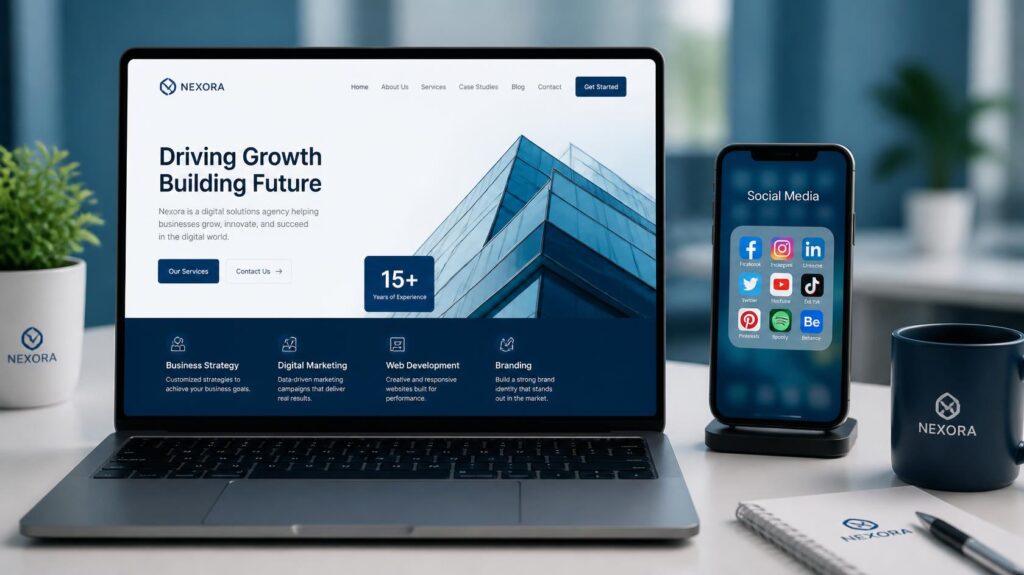
Website vs social media is an important consideration for businesses building a strong online presence. Imagine someone discovers your business through Instagram, TikTok, Facebook, LinkedIn, or a recommendation from a friend. They may become interested in what you offer, but what happens next?
They may search for your business on Google, visit your social media profile, or look for a website where they can learn more about your products and services.
This is where the website vs social media question becomes important.
Many small businesses wonder whether they really need a website when social media platforms already provide a free way to showcase products, communicate with customers, and promote their brand. For some businesses, social media can be an excellent starting point. However, a business website and social media serve different purposes.
Social media is powerful for discovery, engagement, conversation, and community building. A website, on the other hand, gives your business a dedicated digital home where you control the structure, content, customer journey, and brand experience.
Therefore, the question is not always whether a website is better than social media. The more useful question is how each channel can support your business goals.
For many businesses, the strongest digital strategy is not website vs social media, but a combination of both.
Quick Answer: Website vs Social Media for Business
A website and social media are not direct replacements for each other. They perform different functions within a digital marketing strategy.
Social media is particularly useful for reaching audiences, building communities, sharing updates, and encouraging conversations. A business website is more useful for establishing a permanent online presence, explaining products or services in detail, supporting SEO, generating leads, and providing a destination that your business controls.
In most cases, businesses benefit from using both.
Social media can help people discover your business, while your website can give them a deeper understanding of what you offer and guide them toward contacting you, making a purchase, booking a service, or taking another valuable action.
The right balance depends on your business model, target audience, resources, and digital goals.
What Is a Business Website?
A business website is a dedicated online presence that represents a company, brand, organization, or professional service. Unlike a social media profile, a website can be structured specifically around your business objectives and customer journey.
A simple business website might include a homepage, about page, services or product pages, portfolio, testimonials, blog, frequently asked questions, and contact information.
Larger businesses may require more extensive features such as customer portals, online booking, e-commerce functionality, recruitment pages, knowledge bases, or integrations with other business systems.
More importantly, the website gives businesses control over how information is presented.
You decide which services receive attention, how your brand is positioned, what information customers see first, and where visitors should go next.
A website can also become an important foundation for search engine optimization. Individual pages can target different search intents and provide useful information that helps potential customers discover your business through search engines.
This does not mean that having a website automatically guarantees high rankings. Instead, a well-structured website provides a foundation that can support long-term organic search efforts.
What Is Social Media for Business?
Social media for business refers to using platforms such as Instagram, Facebook, TikTok, LinkedIn, YouTube, and other social networks to communicate with audiences and promote a business.
Unlike a traditional website, social media is designed around interaction and ongoing content distribution. Businesses can publish updates, share videos, respond to comments, answer questions, build communities, collaborate with creators, and communicate directly with customers.
This makes social media particularly effective for businesses that depend on visual content, trends, personal interaction, or frequent updates.
For example, a restaurant can use Instagram or TikTok to showcase new dishes. A fashion brand can demonstrate products through short videos. A consultant can use LinkedIn to share professional insights. A local business can use Facebook to communicate promotions and community updates.
However, social media also comes with limitations.
Businesses operate within the rules, algorithms, features, and policies of each platform. The platform controls how content is distributed, how profiles are displayed, and which features are available.
For that reason, social media can be an extremely valuable marketing channel without necessarily replacing the need for a business website.
Website vs Social Media: Key Differences
The biggest difference between a business website and social media is control and purpose.
A website is a digital property built around your business. You control its structure, pages, navigation, content, branding, and customer journey. Social media, meanwhile, operates within a platform created and managed by another company.
This distinction becomes more important as a business grows.
Consider the difference between publishing an important service announcement on a website and posting the same information on social media. On social media, the post can quickly disappear from a customer’s feed as newer content is published. On a website, the information can remain available on a dedicated page that customers can find through navigation or search.
In addition, websites and social media serve different stages of the customer journey.
Social media is often effective at attracting attention and encouraging interaction. A website can then provide the detailed information someone needs before making a decision.
Neither channel has to replace the other. The real opportunity is to connect them.
Website vs Social Media for Trust and Credibility
Trust is one of the most important factors when someone is deciding whether to contact or buy from a business.
Social media can certainly help establish trust. Customers can see recent posts, reviews, comments, customer interactions, behind-the-scenes content, and evidence that a business is active.
However, a professional website can provide a different level of context.
A website can bring important information together in one place, including:
- Company background
- Products and services
- Portfolio and case studies
- Customer testimonials
- Frequently asked questions
- Contact information
- Business location
- Policies and terms
- Educational content
This is particularly valuable for businesses selling professional services, higher-value products, or solutions that require customers to do more research before making a decision.
For example, a potential client considering a web design agency may want to understand its services, previous projects, process, pricing approach, and expertise before starting a conversation.
Social media can introduce the agency. A website can provide the deeper information needed to evaluate it.
For this reason, businesses should think of their website as an important part of their trust-building system rather than simply an online brochure.
Website vs Social Media for SEO and Search Visibility
One of the clearest differences between websites and social media is how they support search visibility.
A business website can contain multiple pages, each created around a specific topic, service, product, or search intent. These pages can be crawled, indexed, and potentially displayed in relevant search results when they provide useful information.
In contrast, social media content is generally designed around platform-specific discovery and engagement.
Social platforms can appear in search results, and social profiles can certainly contribute to a brand’s online presence. However, businesses have less control over how individual social posts are discovered over time.
A website gives you the opportunity to build a broader content ecosystem.
For example, a web design company could create:
- A web design service page
- A business website guide
- A website pricing guide
- A website maintenance article
- A website vs social media comparison
- Case studies
- Frequently asked questions
Each page can address a different user need.
As a result, a website can support a long-term SEO strategy in a way that is difficult to replicate through social media alone.
Businesses should also remember that SEO is not simply about adding keywords. Search engines increasingly focus on whether content is useful, relevant, accessible, and trustworthy. A website therefore needs good content, logical structure, technical performance, and a positive user experience.
Google’s SEO Starter Guide also provides practical guidance on helping search engines understand and discover website content.
For additional guidance, businesses can refer to Google Search Essentials, which outlines the technical requirements, spam policies, and key best practices for appearing in Google Search.
Website vs Social Media for Lead Generation
Both websites and social media can generate leads, but they often do so in different ways.
Social media can generate interest through posts, videos, advertisements, direct messages, comments, and recommendations. A customer may see a piece of content, become interested, and send a message to the business.
A website can provide a more structured conversion path.
For example, a visitor might arrive on a service page, read about the solution, review previous work, check frequently asked questions, and then complete a contact form.
The business can design this journey intentionally.
A website can also include different conversion opportunities, such as:
- Contact forms
- WhatsApp buttons
- Booking forms
- Quote requests
- Newsletter subscriptions
- Product purchases
- Consultation requests
- Downloadable resources
More importantly, the website can organize these actions around specific business goals.
Social media remains valuable because it can drive people toward those conversion points. Instead of thinking about website and social media as competing channels, businesses can use social media to attract attention and the website to help convert that attention into meaningful action.
Who Controls the Content: Website vs Social Media?
Another important difference is ownership and control.
When you publish content on a social media platform, you are using infrastructure controlled by that platform. The interface, algorithm, distribution system, advertising options, and platform policies can change over time.
For that reason, businesses should avoid depending entirely on a single social media platform.
A website gives a business much greater control over its digital presence. You can decide how pages are organized, how information is presented, what content is published, and how visitors move through the site.
This does not mean that social media is unreliable or unimportant. Social platforms can be incredibly effective marketing channels.
The point is diversification.
In other words, social media can help you reach an audience, while your website gives that audience a stable destination that your business controls.
Building both channels creates a stronger digital foundation than relying entirely on one platform.
When Should a Small Business Build a Website?
There is no single moment when every small business must build a website. The right timing depends on the business model, customers, goals, and resources.
However, there are several signs that a business may be ready for a dedicated website.
You should seriously consider building a website if:
- Customers frequently ask the same questions about your products or services.
- People search for your business online.
- You want to appear in Google search results.
- Your business relies on professional credibility.
- You need a central place for your portfolio or case studies.
- You want to generate leads beyond social media messages.
- You are running advertising campaigns and need a dedicated landing destination.
- Your business is growing and your social media profile is becoming difficult to use as an information hub.
In addition, a website becomes particularly valuable when customers need more information before making a purchase or contacting the business.
A local service provider, consultant, agency, contractor, healthcare practice, restaurant, or professional firm may benefit from having a website because customers often want to research the business before taking the next step.
The website does not have to be complicated.
For a small business, a focused five- to seven-page website can often provide a strong starting point.
When Social Media May Be Enough for a Business
Although websites offer significant advantages, not every new business needs to build a large website immediately.
Social media may be enough as a temporary starting point for businesses that are still testing an idea, have a very limited budget, or primarily depend on direct conversations and social discovery.
For example, someone starting a small handmade-product business might initially use Instagram or TikTok to test products, understand customer demand, and build an audience.
At this stage, investing heavily in a complex website may not be the highest priority.
However, businesses should recognize the limitations of this approach.
As the business grows, customers may expect more detailed information, easier ways to contact the company, product pages, reviews, policies, or a more professional digital presence.
Therefore, social media can be a practical starting point without necessarily being the final digital strategy.
The important thing is to recognize when the business has outgrown the limitations of a social-only presence.
Why Businesses Should Use Both a Website and Social Media
For most established businesses, the choice does not need to be website versus social media.
Instead, the two channels can support each other.
Social media is excellent for reaching people where they already spend time. Businesses can use it to publish educational content, showcase products, share updates, answer questions, and build relationships.
The website can serve as the central destination where people can find complete information about the business.
This creates a simple ecosystem:
Social media → discovery → website → information → trust → conversion
For example, a customer might discover a business through an Instagram Reel. They may then visit the company’s website to explore its services, read testimonials, view its portfolio, and submit a contact form.
As a result, each channel has a clear role instead of competing for the same purpose.
This approach can also make marketing activities more organized. Social media can generate attention while the website provides a stable place where that attention can be converted into inquiries, bookings, sales, or other business outcomes.
How a Website and Social Media Can Work Together
A strong digital strategy connects the two channels instead of treating them as separate worlds.
One simple approach is to use social media content to direct people toward useful website pages.
For example:
- An Instagram post can link to a relevant service page.
- A TikTok video can direct viewers to a detailed guide.
- A LinkedIn post can link to a company case study.
- A Facebook promotion can direct customers to a landing page.
- A YouTube video can point viewers toward a product or booking page.
The website can also encourage visitors to follow the business on social media.
In this way, both channels can strengthen each other.
Content can also be repurposed. A detailed blog article can become several social media posts, short videos, LinkedIn updates, or email content.
This can make content marketing more efficient because one valuable piece of information can serve multiple channels.
More importantly, the website remains the central source where the complete version of the information is available.
Common Website and Social Media Mistakes
Businesses can make mistakes when they treat website and social media as interchangeable.
One common mistake is relying entirely on a social media profile without considering long-term search visibility or ownership.
Another is building a website but never updating it. An outdated website can create almost as many trust problems as having no website at all.
Businesses also sometimes create websites without a clear purpose. They may focus heavily on colors, animations, and visual effects while making important information difficult to find.
For example, a potential customer should not have to search through several pages just to discover what a company actually offers or how to contact it.
Another common mistake is using social media only for promotional posts. Audiences are more likely to engage when businesses provide useful information, demonstrate expertise, answer questions, and communicate authentically.
Ultimately, the strongest approach is to give each channel a clear purpose.
Your website should provide a reliable digital home for your business. Social media should help you reach, engage, and communicate with your audience.
When both are managed strategically, they can become complementary parts of the same digital marketing system.
A Practical Website and Social Media Strategy for SMEs
Small and medium-sized businesses do not need to build a complicated digital marketing system from day one. What matters more is creating a clear foundation and expanding it as the business grows.
A practical approach can start with a simple business website and one or two social media platforms where your target customers are most active.
First, make sure the website clearly explains what the business does, who it serves, and how customers can get in touch.
Next, use social media to distribute useful content and attract attention to the business.
Then, connect relevant social media content to specific website pages rather than always sending visitors to the homepage.
For example, a social media post about a particular service can link directly to that service page. A post answering a common customer question can link to a relevant blog article.
This approach creates a more useful customer journey while keeping the marketing process manageable.
Over time, the business can expand its website with additional service pages, case studies, educational content, landing pages, or other features based on customer needs.
How to Decide Between a Website and Social Media
If you are still unsure where to invest your time and budget, consider the following questions:
Do customers search for your business or services online?
If yes, a website can help create a stronger search presence.
Does your business require customers to research before making a decision?
If yes, a website can provide the detailed information they need.
Does your business depend heavily on visual content and community engagement?
If yes, social media should be an important part of your strategy.
Do you need a professional place to showcase your services, portfolio, or case studies?
A website is generally more suitable for this purpose.
Do you want to generate leads through forms, bookings, or dedicated landing pages?
A website can provide more control over these conversion paths.
Are you just testing a new business idea?
Social media may be a practical place to start while you validate demand.
Ultimately, the answer depends on your goals. For many growing businesses, the most effective solution is to establish a website as the foundation and use social media as a channel for discovery and engagement.
Website vs Social Media: A Simple Comparison
Business Website
- Greater control over content and structure
- Supports long-term SEO efforts
- Provides a central source of business information
- Can support multiple conversion paths
- Suitable for services, products, portfolios, case studies, and educational content
- Can be expanded as the business grows
Social Media
- Strong for audience discovery and engagement
- Useful for short-form and visual content
- Supports direct conversations with customers
- Can help businesses build communities
- Useful for promotions, announcements, and real-time updates
- Works well for distributing content and driving traffic
Website + Social Media
- Combines discoverability with a controlled digital destination
- Creates more opportunities to build trust
- Supports multiple stages of the customer journey
- Reduces dependence on a single digital platform
- Allows content to be distributed across multiple channels
- Creates a stronger foundation for long-term digital growth
So, Does Your Business Need a Website or Social Media?
The answer is usually not one or the other.
If your business is just getting started, social media can be an affordable way to test your offer, reach potential customers, and learn what type of content generates interest.
As your business becomes more established, a professional website can provide the structure, credibility, search visibility, and conversion opportunities that social media alone may not provide.
For businesses that already have an active social media presence, there is no need to abandon it. Instead, use social media to attract and engage people while using your website as the central destination for detailed information and business actions.
In simple terms:
Social media helps people discover and interact with your business. A website helps people understand, trust, and take action.
Together, they can create a much stronger digital presence than either channel working alone.
If you want to understand why having a professional website matters beyond simply having an online presence, read our guide: Why Your Business Needs a Professional Website in the Digital Era.
Frequently Asked Questions About Website vs Social Media for Business
Is a website better than social media for a small business?
Not necessarily. A website and social media serve different purposes. Social media can be effective for reaching audiences, building engagement, and sharing frequent updates, while a website provides a more controlled place for business information, SEO, credibility, and lead generation. For many small businesses, using both provides the strongest long-term strategy.
Can a business succeed without a website?
Yes, some businesses can operate successfully without a website, particularly when they rely heavily on social media, marketplaces, referrals, or direct communication. However, depending entirely on third-party platforms can limit control over your online presence. As a business grows, a website can provide a more stable digital foundation for search visibility, credibility, customer information, and lead generation.
Do I need a website if my business already has Instagram or TikTok?
In many cases, yes. Instagram and TikTok can help people discover and interact with your business, but they do not provide the same level of control as a dedicated website. A website can give customers a central place to learn about your services, explore your portfolio, read useful information, and contact your business. Social media and a website can work together rather than replacing each other.
Does social media help with SEO?
Social media can support a business’s overall online visibility and help people discover and share its content. However, social media activity should not be treated as a direct replacement for a well-structured website and SEO strategy. A business website gives you dedicated pages that can be optimized around relevant topics, services, products, and search intent.
How much does a business website cost?
The cost varies depending on the type of website, number of pages, design requirements, functionality, content, integrations, and ongoing maintenance. A simple company profile website generally requires fewer resources than an e-commerce platform or a website with custom functionality. Instead of focusing only on the lowest price, businesses should consider whether the website can support their goals, customer experience, and long-term growth.
Should I focus on SEO or social media first?
The right priority depends on the business and its target audience. Social media may be useful for quickly building awareness and testing content, while SEO can support long-term organic discovery through search engines. For many businesses, combining both is more effective. Social media can generate attention and engagement, while SEO and a business website can help capture people who are actively searching for relevant products or services.
What is the best digital marketing strategy for a small business?
There is no single strategy that works for every business. A practical starting point is to build a clear online presence, understand where your target customers search for information, create useful content, and provide an easy way for people to contact or buy from you. For many small businesses, a professional website combined with one or two relevant social media platforms can provide a strong foundation. The strategy can then expand based on customer behavior and business goals.
Ready to Build a Stronger Online Presence?
Your website and social media should work together to support your business goals. Rafora Digital can help you build a modern, professional website that gives your business a stronger digital foundation.
Need a Professional Website for Your Business?
Whether you are starting a new business website or improving an existing one, the right structure can make it easier for customers to find information, understand your services, and take action.
Rafora Digital helps businesses create modern websites designed around usability, credibility, and long-term digital growth.
Take the Next Step With Rafora Digital
A strong online presence starts with a clear strategy. If your business is ready to move beyond relying on social media alone, a professional website can provide the foundation you need to grow online.
Explore Rafora Digital and discover how a modern business website can support your brand, customers, and long-term goals.